Posts Tagged night sky
Thank You, Internet, For this Strange Bit of Sky
Posted by mistergroonk in Animation, Intertube Madness on June 21, 2011

We don’t know where this came from or who made it but we like where it’s going.
Our Strange Sky: The Auroral Rings of Iceland
Posted by mistergroonk in Just Freaking Neat, Photography, Space on May 17, 2011
We’ve returned, faithful reader! The battle for reliable Internet connectivity has been won. And the winner is everyone.
While we get back into the groove of things, have a look at Iceland’s beautiful green sky.
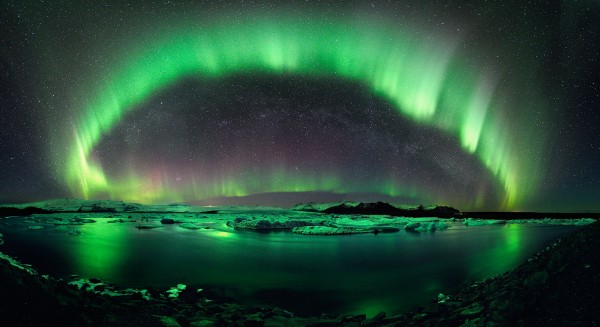
On this night, the sky was not only the best show in town, but a composite image of the sky won an international competition for landscape astrophotography. The above winning image was taken two months ago over Jökulsárlón, the largest glacial lake in Iceland. The photographer combined six exposures to capture not only two green auroral rings, but their reflections off the serene lake. Visible in the distant background sky is the band of our Milky Way Galaxy, the Pleiades open clusters of stars, and the Andromeda galaxy.
via APOD
Our Strange Sky: Meteor Streaks Huntsville, Scottsboro.
Posted by mistergroonk in Alabama, Science, Video on June 4, 2010

It was bright.
It was shiny.
It skipped off the skin of the Earth.
Meteor!
SCOTTSBORO, AL (WAFF) – On May 18th, NASA cameras at the Marshall Space Flight Center and Walker County Science Center near Chickamauga, Georgia tracked the entry of a large meteor estimated to weigh some 60 pounds over northeastern Alabama.
This meteor was first picked up at an altitude of 47 miles over northwest Huntsville, moving at a speed of 8 miles per second towards the southeast. It was last visible northeast of Gurley at an altitude of 23 miles.
The meteor was quite bright, with an intensity rivaling that of the waxing crescent Moon (in astronomical terms, it was about visual magnitude -8.3). Calculations automatically performed by the tracking software indicates that this interloper was from the main asteroid belt, moving in an orbit which takes it more than three times Earth’s distance from the Sun.
Observe HQ video and non-altered imagery over on WAFF’s webhouse.
They think pieces of it may have landed north of Woodville and Scottsboro. If any of you find it, NASA would love a piece of it.
If you think you may have seen the meteor, call Dr. Bill Cooke at 256-544-9136 begin_of_the_skype_highlighting              256-544-9136      end_of_the_skype_highlighting email him at william.j.cooke@nasa.gov.
Worth noting: it might not be a bad idea to alert the Meteorite Men if any of you sky-watchers find this cold piece from the heavens.
via waff
Update: NASA still wants your help finding the meteorite.
Coming Soon: The ‘Interplanetary Internet’
Posted by mistergroonk in Just Freaking Neat, Space on December 1, 2008
Last month, while I was busy focusing on nothing but movies(trailers), science was busy amazing the crap out of the world with their innovations.
NASA has finished its first deep-space test of what could become an ‘interplanetary internet’. The new networking commands could one day be used to automatically relay information between Earth, spacecraft, and astronauts, without the need for humans to schedule transmissions at each point.
Spacecraft beyond Earth’s orbit usually communicate directly with Earth – the first to do so through an intermediary were the Mars Explorations Rovers, which launched in 2003. The Spirit and Opportunity rovers transmit data to orbiters, which then send the data back to Earth.
[…]
A new method would automate and streamline this process by sending data through an interplanetary ‘internet’. Just as data is sent from one point to another on the internet via a linked network of hubs, or nodes, spacecraft scattered throughout the solar system could be used as nodes to transmit data through space.
Do you know what this means, people?! The future world as depicted in Cowboy Bebop, is becoming a legitimate jam session.
The Cortex will be a reality. At the speed of thought we will send waves across the system of Sol. The truth of the signal will be spread far and wide. Even the likes of the puppet theater will be forced to admit, “You can’t stop the signal.”
(via new scientists, grinding.be)
New “Minor Planet” Found Near Neptune
Posted by mistergroonk in Admin, Space on August 18, 2008

Something new in the night sky, for the moment anyways.
Using the Sloan Digital Sky Survey, astronomers detected a small, comet-like object called 2006 SQ372, which is likely made of rock and ice. However, its orbit never brings it close enough to the sun for it to develop a tail. Its unusual orbit is an ellipse that is four times longer than it is wide, said University of Washington astronomer Andrew Becker, who led the discovery team.
[…]
2006 SQ372 is beginning the return leg of a 22,500-year journey that will take it to a distance of 150 billion miles, nearly 1,600 times the distance from the Earth to the Sun. Scientists believe the object is only 50-100 kilometers (30-60 miles) across.
But did you hear about Pluto? Messed up right?
(via universe today)
 Diesel Sweeties
- Is coffee a food, a drug, or –? April 25, 2022
- Johnny Wander
- Johnny Wander - BARBAROUS ½ - 32 November 5, 2026
- Pitch Black
- Karloff May 30, 2019
- XKCD
- Simulation November 6, 2026
Look Closer


- Geeks of Doom
- Book Review: A Feast For A Tenday: The Official Cookbook for Baldur’s Gate 3 (Dungeons & Dragons) Waerloga69
- Halloween Reads 2026: Recommendations For Spooky Season Books, Gifts & More Empress Eve
- Book Review: Travis Baldree’s Legends & Lattes: The Graphic Novel Empress Eve
- Book Review: Interview With The Vampire 50th Anniversary Edition By Anne Rice Empress Eve
- Naked Imagination
- The Old Man December 10, 2012
- When the eyes close December 10, 2012
- Nerdist
- Daft Punk Meets Marvel, E.T. and more in 2026 LEGO Holiday Ad November 6, 2026
- Disney Is Developing a Live-Action Medusa Film November 6, 2026
- Nick Holmes
- Thanks Internet; revisited. May 13, 2026
- Science! December 20, 2025
- Warren Ellis
- home August 13, 2020
- Wil Wheaton
- I wish I really were a Traveler of all of space and time. October 29, 2026
- in which i am turned into a little plushie thing October 27, 2026