Posts Tagged Astronomy Picture of the Day
Music Break: Cassini Solstice Mission Set to Nine Inch Nails “Ghosts”
Posted by mistergroonk in Just Freaking Neat, Music, Photography, Space, World on June 9, 2011
Vimeo’s Chris Abbas honors the lads and lasses working on the Cassini Solstice Mission by sexing up the images caught by Cassini with the sounds of NIN Ghosts I–IV.
Open your eyes. Darken your room and/or cubicle and absorb.
CASSINI MISSION from Chris Abbas on Vimeo.
This is the perfect opportunity for a Carl Sagan quote:
“Somewhere, something incredible is waiting to be known.”
The footage in this little film was captured by the hardworking men and women at NASA with the Cassini Imaging Science System. If you’re interested in learning more about Cassini and the on-going Cassini Solstice Mission, check it out at NASA’s website:
Our Strange Sky: The Auroral Rings of Iceland
Posted by mistergroonk in Just Freaking Neat, Photography, Space on May 17, 2011
We’ve returned, faithful reader! The battle for reliable Internet connectivity has been won. And the winner is everyone.
While we get back into the groove of things, have a look at Iceland’s beautiful green sky.
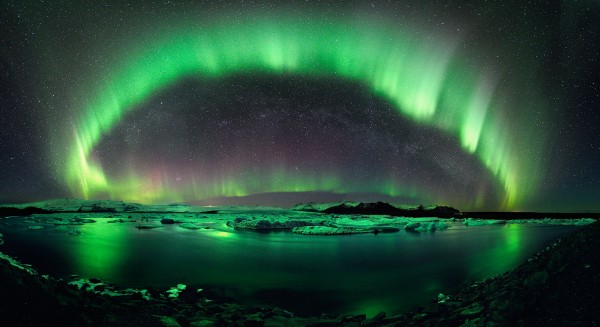
On this night, the sky was not only the best show in town, but a composite image of the sky won an international competition for landscape astrophotography. The above winning image was taken two months ago over Jökulsárlón, the largest glacial lake in Iceland. The photographer combined six exposures to capture not only two green auroral rings, but their reflections off the serene lake. Visible in the distant background sky is the band of our Milky Way Galaxy, the Pleiades open clusters of stars, and the Andromeda galaxy.
via APOD
Our Strange Sky: Above Hungary, Time Lapse of Discovery Separating from the ISS
Posted by mistergroonk in Photography, Space on March 10, 2011
“What’s happening here?” you ask. “Why is this so important?”
What you’re seeing below is a time lapse of the Space Shuttle Discovery separating from the International Space Station in the sky over Lake Bakonybél in Hungary. Being city(ish) bound it is rare we get to see the majesty of a non-light polluted sky. Any time something humans made is visible from the ground we can’t help but to smile and dream of a time we’ll be able to fly our own rocket ship to the moon and beyond.
Check out a video of these sequence below the jump.

Along with stars setting in the west, the two bright celestial beacons, Moon above and Jupiter below, leave short trails in this well-planned time exposure, a composite of 54 individual frames each 4 seconds long. On its final flight, the Space Shuttle Discovery and International Space Station form the second close pairing in the night skyscape. Still glinting in the sunlight in low Earth orbit, they gracefully trace overlapping arcs from lower right to upper left. Moon, Jupiter, Discovery, and ISS are reflected in the calm waters of Lake Bakonybél, Hungary.
Good Morning, ISS Astronaut Tracy Caldwell Dyson. How Does Earth Look Today?
Posted by mistergroonk in Books, Photography, Science, Space on November 17, 2010
BoingBoing tells us:
Madeleine Robins called this picture of ISS astronaut Tracy Caldwell Dyson watching the spin far below, “The perfect cover for the perfect unwritten/unread SF novel I wanted to read when I was thirteen.” Exactly right.
Damn right, BoingBoing.

The above image was taken in late September from the ISS’s Cupola window bay. Dr. Dyson is a lead vocalist in the band Max Q.
There’s an astronaut band out there and no one told us?
This won’t do, Internet. Stop keeping these need-to-know bits of information a secret.
Look…Up in the Sky!
Posted by mistergroonk in Photography on October 28, 2004
Flipped through Astronomy Picture of the Day‘s month of October. Two wicked awesome pictures were found:
Moon Lightning

Moonsets are not often quite as exciting as this one. But amateur astronomer Marc-Andre Besel was impressed by the brilliant lighting displays that joined the first quarter Moon and stars of the constellation Scorpius in western skies. On August 22, 2004, his view looked across the Gulf of Mexico from Anna Maria Island, Florida, USA, a region that would experience even more stormy weather in the coming days
Contrails

Artificial clouds made by humans may become so common they change the Earth’s climate. The long thin cloud streaks that dominate the above satellite photograph of Georgia are contrails, cirrus clouds created by airplanes. The exhaust of an airplane engine can create a contrail by saturating the surrounding air with extra moisture.
Click the pics for more info on each.
 Diesel Sweeties
- Is coffee a food, a drug, or –? April 25, 2022
- Johnny Wander
- Johnny Wander - BARBAROUS ½ - 32 November 5, 2026
- Pitch Black
- Karloff May 30, 2019
- XKCD
- Simulation November 6, 2026
Look Closer


- Geeks of Doom
- Book Review: A Feast For A Tenday: The Official Cookbook for Baldur’s Gate 3 (Dungeons & Dragons) Waerloga69
- Halloween Reads 2026: Recommendations For Spooky Season Books, Gifts & More Empress Eve
- Book Review: Travis Baldree’s Legends & Lattes: The Graphic Novel Empress Eve
- Book Review: Interview With The Vampire 50th Anniversary Edition By Anne Rice Empress Eve
- Naked Imagination
- The Old Man December 10, 2012
- When the eyes close December 10, 2012
- Nerdist
- Daft Punk Meets Marvel, E.T. and more in 2026 LEGO Holiday Ad November 6, 2026
- Disney Is Developing a Live-Action Medusa Film November 6, 2026
- Nick Holmes
- Thanks Internet; revisited. May 13, 2026
- Science! December 20, 2025
- Warren Ellis
- home August 13, 2020
- Wil Wheaton
- I wish I really were a Traveler of all of space and time. October 29, 2026
- in which i am turned into a little plushie thing October 27, 2026