Posts Tagged jupiter
Our Strange Sky: Above Hungary, Time Lapse of Discovery Separating from the ISS
Posted by mistergroonk in Photography, Space on March 10, 2011
“What’s happening here?” you ask. “Why is this so important?”
What you’re seeing below is a time lapse of the Space Shuttle Discovery separating from the International Space Station in the sky over Lake Bakonybél in Hungary. Being city(ish) bound it is rare we get to see the majesty of a non-light polluted sky. Any time something humans made is visible from the ground we can’t help but to smile and dream of a time we’ll be able to fly our own rocket ship to the moon and beyond.
Check out a video of these sequence below the jump.

Along with stars setting in the west, the two bright celestial beacons, Moon above and Jupiter below, leave short trails in this well-planned time exposure, a composite of 54 individual frames each 4 seconds long. On its final flight, the Space Shuttle Discovery and International Space Station form the second close pairing in the night skyscape. Still glinting in the sunlight in low Earth orbit, they gracefully trace overlapping arcs from lower right to upper left. Moon, Jupiter, Discovery, and ISS are reflected in the calm waters of Lake Bakonybél, Hungary.
Wherein Our Local Heavenly Bodies Observe a Recession
Posted by mistergroonk in Space on April 3, 2009
It has come to our attention that the Solar System is tightening its wallet. Our sun is in a Deep Solar Minimum and Jupiter’s Red Spot is not as stormy as it used to be.
The Jovian Eye Looking Smaller Year by Year
The spot, which is actually an ancient monster storm that measures about three Earths across, lost 15 percent of its diameter between 1996 and 2006, scientists at the University of California, Berkeley, have found.It shrank by about 1 kilometer (about 0.6 miles) a day during that time period, said Xylar Asay-Davis, a postdoctoral researcher who was part of the study.
[…]
Astronomers see a dramatic difference in the spot’s shape when comparing photos of Jupiter taken more than a century ago to recent images of the planet. Orton joked that the Great Red Spot used to be so long that its acronym should have stood for the “Great Red Sausage.”“I just happened to look at an old picture and said to myself, ‘That looks like a breakfast sausage.’ It’s very long. I mean, if you look at one of those pictures back from then and a picture now, you think, ‘My God, this thing is going on a diet,” Orton said.
Now eye-shaped, the spot is expected to become circular by about 2040, he added.
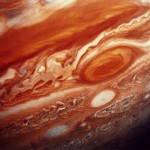
Thanks for making us hungry, astronomer Orton. You’ve blown our breakfast diet for at least a month. How would you like it if we came to your workplace and spoke all day of the pizza rings of Saturn or the oceans of Dr Pepper that lurk just under the surface of Mars.
Also, Faithful Readers, we do not suggest plugging “great red sausage” into your Google search machines at work. Trust us on this.
 Diesel Sweeties
- Is coffee a food, a drug, or –? April 25, 2022
- Johnny Wander
- Johnny Wander - BARBAROUS ½ - 32 November 5, 2026
- Pitch Black
- Karloff May 30, 2019
Look Closer


- Geeks of Doom
- Book Review: A Feast For A Tenday: The Official Cookbook for Baldur’s Gate 3 (Dungeons & Dragons) Waerloga69
- Halloween Reads 2026: Recommendations For Spooky Season Books, Gifts & More Empress Eve
- Book Review: Travis Baldree’s Legends & Lattes: The Graphic Novel Empress Eve
- Book Review: Interview With The Vampire 50th Anniversary Edition By Anne Rice Empress Eve
- Naked Imagination
- The Old Man December 10, 2012
- When the eyes close December 10, 2012
- Nick Holmes
- Thanks Internet; revisited. May 13, 2026
- Science! December 20, 2025
- Warren Ellis
- home August 13, 2020
- Wil Wheaton
- that time we were tourists in los angeles on our anniversary November 9, 2026
- please don’t fuck this up. November 5, 2026