Posts Tagged stars go boom
Texas Fireball Explained: and the World “Exploded in Green!”
Posted by mistergroonk in Science, Space on February 16, 2009
In an effort to recapture my fascination with the Internet, I denied myself the pleasures of Twitter(for the most part) and endeavored to finish other things that needed doing. Things like sunshine and disarming traps making the apartment, once again, guest receivable. As Twitter more addictive than a line of strippers or bags of cocaine dancing around poles, I lurked outside the great internet social party. That’s when I learned of the fireball over Texas.
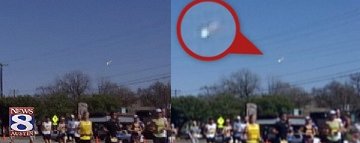
What you just saw was not satellite debris. The high speed of the fireball in the News 8 video is typical of a natural meteoroid hitting Earth’s atmosphere at tens of km/s. Orbital debris, on the other hand, should crawl across the sky at a fraction of that speed. Astronomer Bill Cooke of NASA’s Meteoroid Environment Office has reviewed the video and confirms “it’s a natural meteor, definitely.” According to his analysis, the source of the fireball was a meter-class asteroid traveling at about 20 km/s.
Fireball mania started on Friday the 13th, around 10 p.m. EST, when people in central Kentucky heard loud booms, felt their houses shake, and saw a fireball streaking through the sky: reports. “The world appeared to explode–in green!” said one eyewitness. Once again, this appears to be a natural event caused by a meteoroid. Iridium 33 and Kosmos 2251 collided at a speed of about 10 km/s or 22,000 mph. None of the surviving fragments should have been big enough to shake houses in Kentucky. Furthermore, US Space Command, which monitors objects in Earth orbit, has not announced a reentry over Kentucky on Feb. 13th.
One day, SpaceWeather.com, you will learn of permalinks. On that day, I shall welcome you into post 1990s internet society.
Fireball You Tube video under the cut.
Read the rest of this entry »
Super Fear of Hadron Super Collider, Silly, Won’t Die
Posted by mistergroonk in Technology, The Future on June 30, 2008

“Obviously, the world will not end when the LHC switches on,” said project leader Lyn Evans.
David Francis, a physicist on the collider’s huge ATLAS particle detector, smiled when asked whether he worried about black holes and hypothetical killer particles known as strangelets.
“If I thought that this was going to happen, I would be well away from here,” he said.
People are so eager to believe the CERN will unmake all we know while we’ve be doing this steadily to the environment(our current and only home: Spaceship Earth) for the last 100 years. And some folk still refuse to acknowledge this fact.
Fear of the unknown, anyone?
Over eagerness to blame “mad” scientists for your woes?
Dangerous bouts with infectious stupidity?
(via medicmike, aol news)
Doritos Pollutes Alien Solar System with Advertising
Posted by mistergroonk in Marketing, Space on June 14, 2008
Yes, there are other bits floating around out there in The Black. But most of that noise is unintentional. Including Hitler’s broadcasting the opening of the 1936 Olympics.
This shit here, this is unconscionable.
It could be the longest commercial break in history. Over a six-hour period this morning, high-powered radars in the Arctic Circle broadcast an advertisement into space for the first time.
The advertisement, for Doritos tortilla chips, was being directed towards a solar system in the Ursa Major constellation, just 42 light years from Earth. The solar system contains a habitable zone, and could host an Earth-like planet and extraterrestrial life.
The EISCAT European space station on the Norwegian island of Svalbard sent the message using its array of radars. Those radars are normally used to study the Earth’s upper atmosphere.
[…]
The advert itself is unlikely to be decoded by extraterrestrial life, according to van Eyken. “We’re sending it as an MPEG file coded into 1s and 0s. It’s going to look pretty random,” he says. But repeating the message in a series of regular pulses over several hours should help extraterrestrials identify the message as intelligent, he thinks.
I don’t care, man. When the Space Bears come down from the skies looking at you for thin pieces of cheese covered cardboard, you’ll re-think the wisdom of being a money whore.
(via warren eliis: who has an article you really should read, new scientists)
A Supernova is Born. This Time We Saw It!
Posted by mistergroonk in Science, Space, The Future on June 3, 2008

NASA’s Swift satellite is sensitive to X-rays; it’s designed to detect the flash of light from gamma-ray bursts, which are a particular flavor of supernova. But Swift can also be used to observe older events, too. Alicia Soderberg, an astronomer at Princeton, had gotten time on Swift to observe SN2007uy, a supernova that had exploded the month before. This was a routine observation, and on January 9, 2008, she was actually on travel, ironically giving a talk about supernovae!
When she got back from her talk, she logged onto the Swift archive to look at the data as it came in, and got a huge surprise. There was a second, new source of X-rays in the field of view… and it was incredibly bright. She quickly realized what she was seeing: a new supernova caught in the act, the X-ray flash of the shock breakout detected for the first time. She realized Swift had caught the birth of supernova 2008D as it was happening.
(via badastronomy, digg)
 Diesel Sweeties
- Is coffee a food, a drug, or –? April 25, 2022
- Johnny Wander
- Johnny Wander - BARBAROUS ½ - 32 November 5, 2026
- Pitch Black
- Karloff May 30, 2019
- XKCD
- Simulation November 6, 2026
Look Closer


- Geeks of Doom
- Book Review: A Feast For A Tenday: The Official Cookbook for Baldur’s Gate 3 (Dungeons & Dragons) Waerloga69
- Halloween Reads 2026: Recommendations For Spooky Season Books, Gifts & More Empress Eve
- Book Review: Travis Baldree’s Legends & Lattes: The Graphic Novel Empress Eve
- Book Review: Interview With The Vampire 50th Anniversary Edition By Anne Rice Empress Eve
- Naked Imagination
- The Old Man December 10, 2012
- When the eyes close December 10, 2012
- Nerdist
- Daft Punk Meets Marvel, E.T. and more in 2026 LEGO Holiday Ad November 6, 2026
- Disney Is Developing a Live-Action Medusa Film November 6, 2026
- Nick Holmes
- Thanks Internet; revisited. May 13, 2026
- Science! December 20, 2025
- Warren Ellis
- home August 13, 2020
- Wil Wheaton
- I wish I really were a Traveler of all of space and time. October 29, 2026
- in which i am turned into a little plushie thing October 27, 2026