Posts Tagged Mars
Mars Phoenix “Tastes” Water on Mars, Labels it Win
Posted by mistergroonk in Robots on July 31, 2008

(via boingboingtweet, mars phoenix)
More Love from Mars: Watch Alien Ice Sublimate
Posted by mistergroonk in Just Freaking Neat on June 20, 2008

These images were acquired by NASA’s Phoenix Mars Lander’s Surface Stereo Imager on the 21st and 25th days of the mission, or Sols 20 and 24 (June 15 and 18, 2008).
In the lower left corner, lumps disappear, similar to the process of evaporation.
(via Phoenix Mars Mission)
Mars Phoenix Reports: *Water Ice* on Mars
Posted by mistergroonk in History, Just Freaking Neat on June 20, 2008
No one believed me, so I brought pictures.
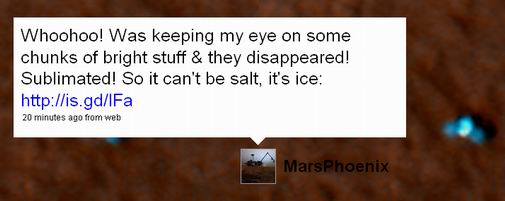

Give me some of that Martian Spring Water.
Mmmm. Tasty.
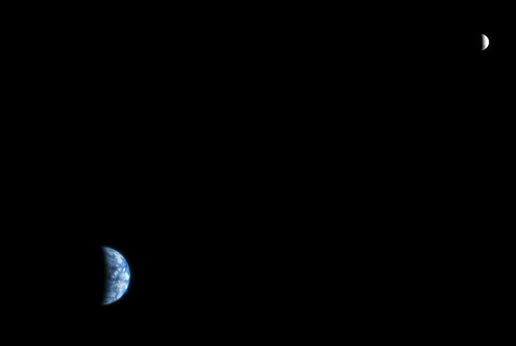
The Earth, as it is from Mars
Posted by mistergroonk in Art, Space on June 10, 2008
READ: Make the Red Planet, Our Planet
Posted by mistergroonk in Admin, Just Freaking Neat, The Future on June 6, 2008
Warren Ellis has been talking an awful lot about Mars this past week. This is a good thing cause Mars has been on my mind for some time now. (Note the filing category of this post.) But yes. “Bending” Mars. Making the Red Planet our planet. Our sister petri dish for continuance of the species. This must happen. Find good things out their Mars Phoenix. Find them and give people an idea on what our next off-planet move will be.
So my characters — and the dark side of my conscience — say what are we waiting for? Let us now bend Mars to our will (and I’m aware of the overtones of both â€run a railroad†and â€willâ€) and fix the place up for human habitation. Let’s cover the bastard in GM lichen and bugs, thicken up the atmosphere, drop a few nukes on Tharsis, do everything we can think of, fast and dirty, because the universe is hiding the stopwatch from us and we don’t know how much time we’ve got left. Let’s get a bit of air pressure happening, see if we can force out some of that water, do what it takes to at least get some overground stations into a safety zone.
Because it’s not doing us any good as a national park. And we are barely clinging to the surface of our world. And not through any fault of our own. Successful human life was a fluke on this planet even before we started poisoning ourselves. Playing the “we need to learn how to look after our planet before we go to another†lament is utterly beside the point. Think about your favourite art, your favourite memories, the best things people ever did. Does that have to go away because some people want Mars to always look like that quarry in Wales where they always shot DOCTOR WHO episodes in the 1970’s?
Read the complete entry “Bending Mars” and its predecessor “Stabbing Mars.”
(via warren ellis, whitechapel )
Scientists Land on Mars, Name it Funny Things
Posted by mistergroonk in Robots, Science, Space on June 5, 2008
Scientists have named the areas around Mars Phoenix. They are a goofy lot, I’ll tell you that for nothing.

Scientists are assigning nicknames to the areas surrounding Phoenix so they can easily identify and discuss features of interest during the mission. This map, for example, shows the workspace reachable by Phoenix’s robotic arm, with “Sleepy Hollow” denoting a trench and “Headless” designating a rock. A “National Park,” marked by purple text and a purple arrow, has been set aside for protection until scientists and engineers have tested the operation of the robotic scoop. In this view, rocks are circled in yellow, other areas of interest in green.NASA/JPL-Caltech/University of Arizona
Also, the Phoenix Lander will talk to you on Twitter if you talk to it first: http://twitter.com/MarsPhoenix
It currently has 17,890 followers. Yet Phoenix follows no one.
Elitist bastard.
(via discovery news, phoenix twitter)
The Rocket City Cares More About a Mall than the Moon
Posted by mistergroonk in Alabama on April 30, 2008
Yeah, it’s a filler piece of news, but I live here(Rocket City/Huntsville) and damn if the article ain’t true. The city where von Braun built spaceships to the moon is more infatuated with the new mall. Space conquests are afterthoughts, if that much.
Yet NASA’s mission to return astronauts to the moon – and eventually send them to Mars – has attracted little public interest here, despite the fact that Huntsville engineers are developing the next generation of rockets for the project, which could create as many as 2,900 jobs in the city within five years.
“In the ’60s and ’70s, it was exciting. Everyone had space fever,” recalled Polly Morton, a longtime resident who works with the city’s tourism bureau.
These days, she said, plans to explore the heavens are overshadowed by more immediate earthly concerns – like the war in Iraq and concerns. about whether the government will have the money to complete the $100 billion Constellation program that began in 2005
“Mars is the next thing,” Morton said. “But right now, because of the war and the funding, it’s not talked about as much.”
It is things like this…
“I don’t know anything about it, and I don’t want to know anything about it unless they bring me back some gas,” said McCall, 21.
…that reminds me I must despise people.
(via 7d, myway news)
Stephen Hawking Knows Something We Don’t, Wants Humans the Hell Off Earth
Posted by mistergroonk in Uncategorized on April 21, 2008
Stephen Hawking called for a massive investment in establishing colonies on the Moon and Mars in a lecture in honour of NASA’s 50th anniversary. He argued that the world should devote about 10 times as much as NASA’s current budget – or 0.25% of the world’s financial resources – to space.
The renowned University of Cambridge physicist has previously spoken in favour of colonising space as an insurance policy against the possibility of humanity being wiped out by catastrophes like nuclear war and climate change. He argues that humanity should eventually expand to other solar systems.
But in a speech in Washington, DC, US, delivered in honour of NASA’s 50th anniversary in 2008, Hawking focused on near-term possibilities, backing the space agency’s goals of returning astronauts to the Moon by 2020 and sending humans to Mars soon after that.
The Moon is a good place to start because it is “close by and relatively easy to reach”, Hawking said. “The Moon could be a base for travel to the rest of the solar system,” he added. Mars would be “the obvious next target”, with its abundant supplies of frozen water, and the tantalising possibility that life may have been present there in the past.
Having all your eggs in one basket *is* a bad idea.
(via new scientist)
Scientists: Oh BTW, Mars won’t get Hit with Asteroid After All KTHXBAI
Posted by mistergroonk in Uncategorized on January 12, 2008
Tracking measurements of asteroid 2007 WD5 taken from four observatories have greatly reduced uncertainties about its Jan. 30 close approach to Mars so that the odds of impact have dropped to 1 in 10,000, the Near-Earth Object Program at NASA’s Jet Propulsion Laboratory said in a posting on its Web site.
Scientists said the best estimate was for the asteroid to pass at a distance of more than 16,000 miles from the surface of Mars, or at worst, no closer than 2,480 miles.
The asteroid was discovered in November by a Congressionally mandated, ongoing search for potentially threatening asteroids and comets. Originally identified as a possible risk to Earth, later analysis showed that the asteroid could be on a collision course with Mars.
Earth’s Geology May be What Keeps Water Wet
Posted by mistergroonk in Admin, Science on January 11, 2008
Hansen recently stirred the pot with a controversial hypothesis published in last month’s issue of the journal Geology. Meteorite impacts early in Earth’s history, she suggested, created the first rifts in the crust, jump-starting plate tectonics.
[…]
Energizer Bunny Tectonics?
“It’s an implicit assumption that plate tectonics never shuts down,” Silver told Discovery News. “But it’s nowhere stated in plate tectonics theory.”Silver and his colleague Mark Behn proposed in the Jan. 4 issue of Science that all it takes to stop plate tectonics is the devouring of the crustal plate under the Pacific Ocean. And that’s not as far-fetched as it sounds.
[…]
The end result would be a supercontinent, no remaining subduction zones, and virtually no plate tectonics, at least for a while.
(via disovery news)
 Diesel Sweeties
- Is coffee a food, a drug, or –? April 25, 2022
- Johnny Wander
- Johnny Wander - BARBAROUS ½ - 32 November 5, 2026
- Pitch Black
- Karloff May 30, 2019
Look Closer


- Geeks of Doom
- Book Review: A Feast For A Tenday: The Official Cookbook for Baldur’s Gate 3 (Dungeons & Dragons) Waerloga69
- Halloween Reads 2026: Recommendations For Spooky Season Books, Gifts & More Empress Eve
- Book Review: Travis Baldree’s Legends & Lattes: The Graphic Novel Empress Eve
- Book Review: Interview With The Vampire 50th Anniversary Edition By Anne Rice Empress Eve
- Naked Imagination
- The Old Man December 10, 2012
- When the eyes close December 10, 2012
- Nerdist
- New INTERSTELLAR LEGO Set in the Works November 9, 2026
- Paramount+ and HBO Max Will Bundle in Early 2027 November 9, 2026
- Nick Holmes
- Thanks Internet; revisited. May 13, 2026
- Science! December 20, 2025
- Warren Ellis
- home August 13, 2020
- Wil Wheaton
- that time we were tourists in los angeles on our anniversary November 9, 2026
- please don’t fuck this up. November 5, 2026