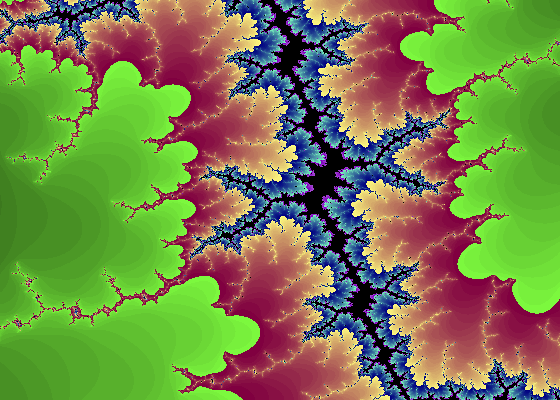
Why fractals you ask?
Long story I say. Just enjoy the pretty designs:
Fractals were first described in the 1970s by IBM mathematician Benoit Mandelbrot, who was driven by the urge to find “a new geometry of nature.” Mandelbrot found traditional geometry to be “cold and dry”; it could not describe the enormous and irregular shape of a mountain; it had no formal representation of the appearance of a cloud. The new geometry that he developed could do all this; it was a description of the beautiful yet irregular and fragmented patterns around us.The term ‘fractal’ was coined by Mandelbrot from the Latin fractus, an adjective for the irregular and the fragmented. Essentially, fractals are mathematical hydras. They replicate themselves by fragmentation. You look at a fractal pattern and you see a form; then you look closely at a particular region of the pattern, and you see the same form all over again, only much smaller this time. And so on it goes, from the largest scales to the smallest — a repetition of the same structural form, a self-similar solution that goes on ad infinitum.
In the past two decades, mathematicians have found that fractals can be used to describe a broad range of phenomena, from the workings of stock markets worldwide to ripples on the high seas. Coastlines can be beautifully simulated using Mandelbrot’s geometry — every nook and cranny on the shore is replicated by fractals.